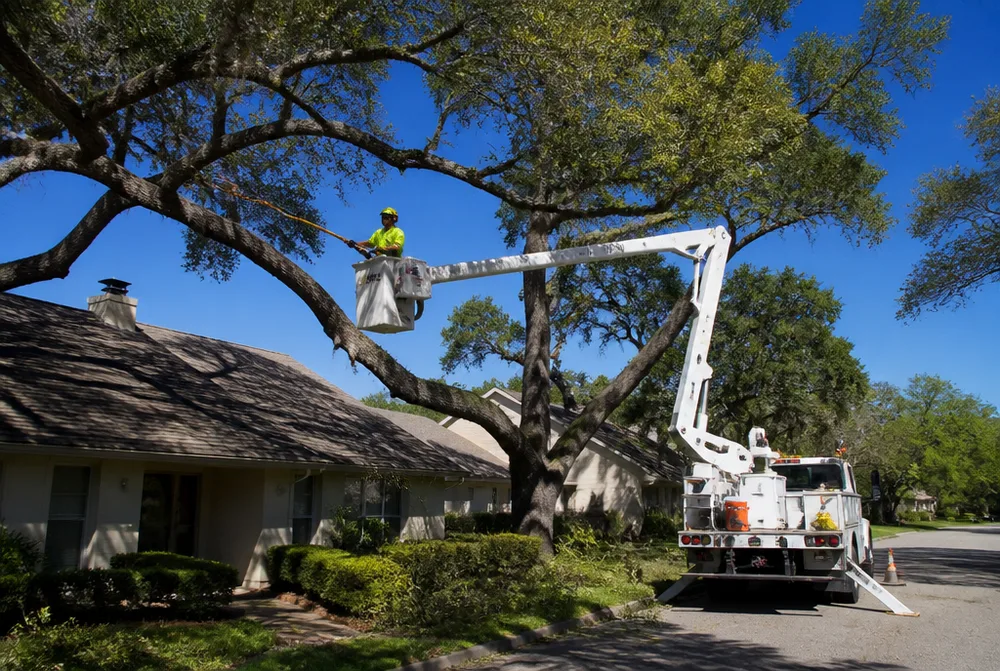
Huntsville Tree Removal Pros trims and prunes trees across Huntsville to keep them healthy, safe, and shaped -- structural pruning, deadwooding, and canopy thinning rather than a topping job that damages a tree's long-term health.
How We Handle Tree Trimming & Pruning
Structural Pruning
Young and established trees both benefit from structural pruning that guides growth and prevents future storm-damage risk from weak branch unions.
Deadwooding
Removing dead and dying limbs before they fall on their own -- a lower-cost, preventive alternative to waiting for a limb failure.
Canopy Thinning
Selective thinning reduces wind resistance and storm risk on mature trees without the aesthetic and health damage of over-pruning.
Clearance Pruning
Trimming branches back from rooflines, power lines, and structures for clearance -- a common, lower-cost service that prevents bigger problems.
Improper pruning -- topping, over-thinning, flush cuts -- causes long-term damage and actually increases storm-damage risk on the next severe weather event by producing weak, fast regrowth. We prune to ANSI A300 standards rather than a quick, cheap cut that looks fine for a season and creates a bigger problem in three years.
The Main Types of Pruning
Crown cleaning removes dead, dying, diseased, and broken branches -- the most common job, and the one that matters most for safety. Crown raising removes lower limbs to clear a roof, a driveway, a sidewalk, or a view. Crown thinning takes out selected branches throughout the canopy to let light and wind through. Crown reduction shortens a tree's height or spread by cutting back to smaller side branches -- the right way to do what people usually mean when they ask for topping.
Why Topping Is the Wrong Answer
Topping -- cutting a tree's main branches back to stubs -- is what a lot of people picture when they want a tree cut down to size. The International Society of Arboriculture considers it an unacceptable pruning practice: the big stub wounds decay, and the fast shoots that grow back are weakly attached and prone to breaking in storms.
The professional standard for pruning in the U.S. is ANSI A300 Part 1; the current edition of the A300 standards dates to 2023. A proper reduction cut goes back to a side branch big enough to take over, which keeps the tree's structure intact.
Trees Near Power Lines: Who Trims What
Huntsville Utilities trims trees near its lines to keep them clear, and says it uses natural trimming methods -- side trimming, drop-crotch cuts, and removing overhanging limbs. The service wire from the pole to your house is yours to keep clear, according to the utility.
Huntsville Utilities says homeowners who trim near its lines have to meet its line-clearance standards, and it offers one-for-one replacement vouchers at participating nurseries when a street-side tree is removed. Before anyone trims close to a line, check with Huntsville Utilities first.
Bradford Pears Need Early Attention
The Alabama Cooperative Extension System notes that the Bradford pear turned out to be structurally weak because of its branching pattern -- narrow angles where the limbs meet the trunk. Those are the trees you see split in half after a windstorm. Early structural pruning helps; on a large, mature Bradford pear with several big limbs coming from one point, removal may be the better long-term answer.
When to Prune
Dead, broken, or hanging limbs should come out whenever you find them. For routine pruning of healthy trees, late fall through winter is a common choice: the leaves are off, and the tree's structure is easy to see. See the cost guide for typical Huntsville trimming prices.
Frequently Asked Questions
How often should trees be pruned?
Most mature trees benefit from pruning every 3-5 years; younger trees may need more frequent structural pruning to establish good form.
Is topping a tree ever a good idea?
No -- topping damages tree health and structure and typically increases future storm-damage risk. We don't offer it as a service.
How much does tree trimming cost?
Most residential trimming jobs run $300-$1,200 depending on tree size and scope -- free on-site quotes.